Digital Disconnect: The New Luxury That Invites Us to Reconnect
For years, luxury was measured in objects. In things that sparkled, that were expensive and hard to obtain, that spoke the language of exclusivity. Yet in a hyperconnected world where technology advances at a dizzying pace and artificial intelligence has become a quiet constant, the true privilege is beginning to be somewhere else. Somewhere silent. Human. Timeless.
Today, true luxury means being offline. Stepping into a space where screens no longer set the rhythm of our days and time falls back into its natural flow. Where our attention, one of the world’s rarest, most treasured resources, finally belongs to us again. A place to listen, to look, to play, to feel, to share with no interruptions, no notifications, no silent algorithm nudging our next move or shaping our thoughts.
Because the more connected we are to the digital world, the more we need to reconnect with ourselves.
Hyperconnection: a trap that catches us without warning
We’re living in a fascinating and deeply contradictory time. We’re surrounded by innovation that makes life easier, by tools capable of anticipating our desires, solving problems in seconds, and taking us further than we ever imagined. Technology is present in every corner of our lives, guiding decisions, projects, tasks, and conversations. And undeniably, it’s a powerful ally.
But this digital saturation comes with a high price: constant noise. The pressure to reply, to produce, to be available. The feeling that if we step offline, we’re missing information, opportunities or presence.
That silent anxiety of always being “on” pushes us toward a life stuck on the surface. Being everywhere without truly being anywhere. Fragmenting our attention. Reacting without pausing, thinking, or diving deeper.
What “offline luxury” really means
The concept of “offline luxury” is the intentional ability and the conscious decision to disconnect from the digital world on our own terms. It’s leaving behind constant notifications and the endless scroll to immerse ourselves in real experiences. Life beyond the screen. True luxury is not having the latest device or being available 24 hours a day, 365 days a year. It’s being able to turn off the phone without anxiety or guilt and devote our time to what nourishes us.
That’s why so many people are beginning to slow down. To seek spaces where they can pause. Moments untouched by devices. Instants that reclaim the beauty of the simple, the essential, the spontaneous, the real. The privilege of presence, of awareness, of savoring what surrounds us.
Luxury today isn’t about having more. It’s about having time. Quality time. Authentic time. Time for ourselves.

Returning to the essential: why humans need to disconnect
Human nature isn’t binary. It doesn’t think in “airplane mode.” It doesn’t live in the instant. We’re not machines with on–off switches. We need pause, contemplation, contact. Silence to hear ourselves. Calm to create. Disconnection to restore our sense of wellness. And we need control over our own time, the power to decide when, how long, and how we step away from the wheel that spins our daily lives.
Because when we disconnect:
Recharge mental energy.
Rediscover our natural creativity.
Nurture our relationships.
Create space for emotion, for deep thought, for conscious presence.
Regain the feeling that we own our time.
Disconnecting isn’t an act of rebellion. It’s an act of care. A commitment to our health and our identity. Ultimately, to our balance and well-being.
And paradoxically, the more technology advances, the more human we need to be. That’s why today, disconnection is a luxury. But a vital one that everyone should have access to.
Wellness as a compass: toward a more conscious life
Many studies agree: excessive screen time affects our sleep, our focus, our eyesight, even increasing the risk of anxiety and depression. The “digital natives generation”, born with a phone in hand, are beginning to feel the strain of living online: the pressure of social validation, cyberbullying, FOMO, are all part of their reality.
But beyond the scientific evidence, there’s a feeling we all recognize: after hours in front of a screen, after too much time on the phone, the tablet, the computer, or the TV… something dims inside.
Hyperconnection has led us to a profound disconnection from ourselves and our surroundings.
And yet, when we allow ourselves a pause, something lights up again. Disconnection isn’t escape: it’s equilibrium. It’s a way to come back to reality. An urgent need to reconnect with our essence and with nature. It’s clarity, presence, and well-being.
This is why more and more people are weaving offline moments into their daily lives. Spaces to breathe. To be. To share. To feel. To return to themselves and place the focus on their emotions, sensations, and inner landscape.
The luxury of simplicity: the invisible revolution of being offline
In a world that accelerates endlessly, slowness becomes a mark of sophistication. Sipping a coffee without checking the phone. Reading a book without distractions. Breaking the digital routine and getting lost in a long conversation. Looking someone in the eyes with no interruptions. Sitting around a table, not to work, but to share. Meeting simply for the pleasure of being together. These scenes, once ordinary, now feel rare. Unique. Precious. Luxurious.
Digital life fills everything, and disconnection has become a refuge. An island in a sea of constant input. A space where we’re no longer competing with screens, where the mind can finally breathe. Because real luxury, the kind that truly lasts, is the one thing no screen can ever replicate.
And there, in that minimalist sanctuary away from pushes and scrolls, appears something that has accompanied us for centuries: play.
Play as a path to digital disconnection and true connection
Artificial intelligence makes life easier. It helps us decide, automates what’s repetitive, allows us to work faster and better. That’s extraordinary. But the most human part of us cannot be delegated. It cannot be compressed into data. It cannot be programmed.
We’re made of nuances, of desires, of doubts and decisions. And that’s why we need rituals that celebrate the tangible. Rituals that remind us that the best experiences can’t be downloaded. They’re lived. Rituals like real play. Play that moves away from screens and brings us physically close. Play that makes us sweat, jump, and laugh in real time.
When we play “in real life,” we rediscover what matters. We laugh again, compete with elegance, celebrate small victories, share glances that say more than any message, reel, or hashtag. We return to who we truly are, without masks or filters that hide our real selves.
Play anchors us to the present.
It forces us to be here.
To touch, move, observe.
To enjoy without rushing.
To build a moment that can’t be repeated or stored in the cloud.
Analog play is a universal language. A bridge between generations. A ceremony of disconnection. A stage where life unfolds far from the screen.
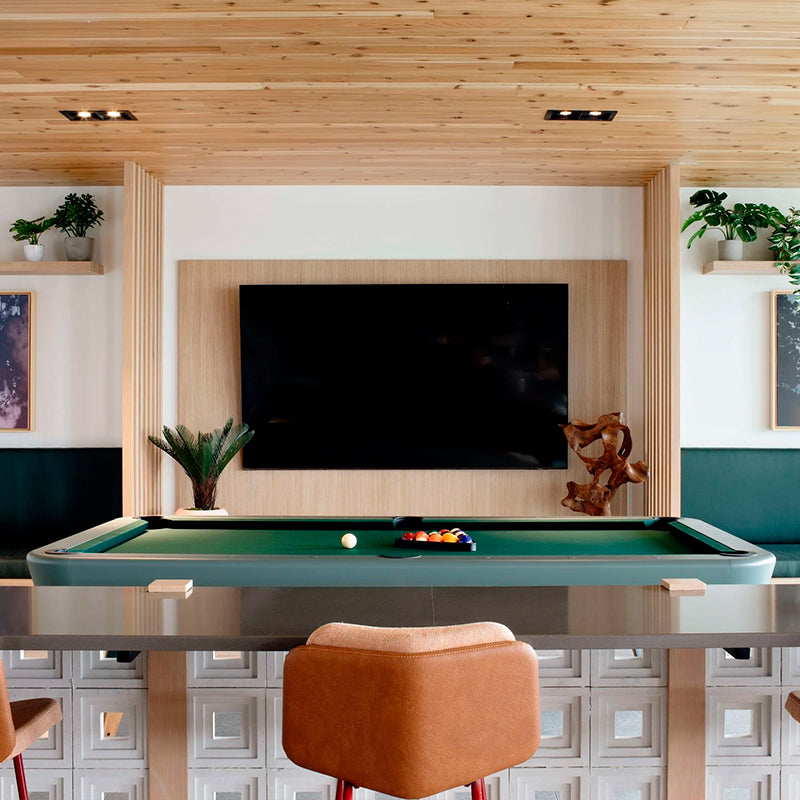
The crack of billiard balls colliding. The knowing gesture of a practiced foosball play. The quiet tension before the final point in a ping pong match. The laughter after an impossible shot. The feel of the shuffleboard puck gliding beneath our fingers. None of these sensations require Wi-Fi. They need no battery. No update. They are the oldest and most authentic form of connection we know.
Play celebrates real life. It’s being here, now. Fully present. Because the greatest luxury isn’t being everywhere. It’s being, truly, where we want to be.